
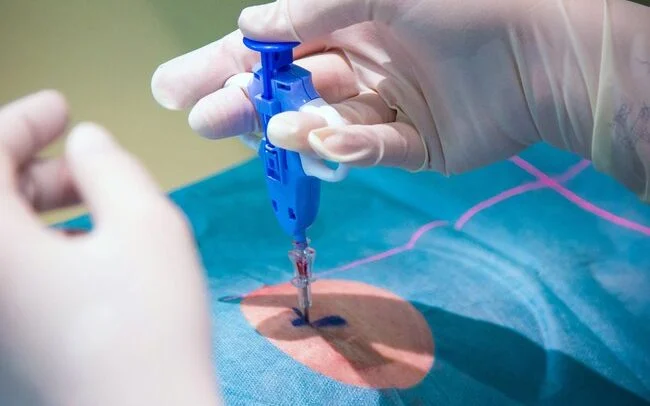
One of the most common questions I hear from patients is:
“Doctor, if you perform a biopsy, won’t the cancer spread?”
Unfortunately, this misconception has existed in our society for decades. Every week, I meet patients who are afraid to undergo a biopsy because a relative, neighbor, social media post, or an unqualified practitioner has warned them that “once the tumor is disturbed, the cancer spreads.”
This fear is understandable—but it is not supported by modern medical evidence.
In fact, delaying a biopsy often allows the cancer to continue growing silently. By the time some patients finally decide to seek treatment, the disease has progressed to a stage where curative treatment may no longer be possible.
As a Surgical Oncologist, one of my responsibilities is not only to treat cancer but also to correct myths that prevent patients from receiving timely care.
Let us understand the truth.
What is a Biopsy?
A biopsy is a medical procedure in which a small sample of tissue is taken from a suspicious swelling or tumor and examined under a microscope by a pathologist.
Think of it as sending a tissue sample to a laboratory to answer one crucial question:
“Is this cancer or not?”
Just as a blood test helps diagnose diabetes and an ECG helps diagnose heart disease, a biopsy is the gold standard for diagnosing cancer.
Without examining the tissue under a microscope, no responsible oncologist can confidently diagnose cancer or plan the most appropriate treatment.
Simply looking at a scan or examining a lump is often not enough. Many non-cancerous conditions can resemble cancer on imaging studies.
What are the Different Methods of Biopsy?
The type of biopsy depends on the location of the tumor, its size, and the suspected diagnosis.
1. Fine Needle Aspiration Cytology (FNAC)
A very thin needle is inserted into the swelling to withdraw cells for examination.
This procedure is quick, usually causes minimal discomfort, and is commonly used for enlarged lymph nodes, thyroid nodules, breast lumps, and superficial swellings.
2. Core Needle Biopsy
A slightly larger needle is used to obtain a small cylinder of tissue.
Because it preserves the architecture of the tissue, it provides much more information than FNAC and is commonly performed for breast, liver, prostate, and many other tumors.
Today, core biopsy is considered the standard diagnostic method for many cancers.
3. Incisional Biopsy
Only a small portion of the tumor is removed.
This is often performed when the tumor is too large to remove completely during the first procedure.
4. Excisional Biopsy
The entire lump is removed and sent for examination.
This approach is commonly used for small skin lesions or enlarged lymph nodes.
5. Endoscopic Biopsy
Using instruments such as an endoscope or colonoscope, tissue samples can be taken from organs like the stomach, esophagus, colon, or rectum.
No large incision is required.
6. Image-Guided Biopsy
Some tumors lie deep inside the body and cannot be safely felt from outside.
In such cases, ultrasound-guided or CT-guided biopsies allow doctors to precisely target the abnormal tissue while minimizing injury to surrounding organs.
Why Do We Need a Biopsy?
Many people believe that scans alone are enough to diagnose cancer.
Unfortunately, that is not true.
A biopsy provides essential information that no scan can reliably offer.
1. To Confirm Whether Cancer is Actually Present
Many benign diseases mimic cancer.
Examples include:
- Tuberculosis
- Fungal infections
- Chronic inflammation
- Benign tumors
- Autoimmune diseases
Treating someone for cancer without confirming the diagnosis would be unsafe and unethical.
2. To Identify the Type of Cancer
“Cancer” is not a single disease.
There are hundreds of different cancers.
For example:
- Squamous cell carcinoma
- Adenocarcinoma
- Lymphoma
- Sarcoma
- Melanoma
- Neuroendocrine tumors
Each behaves differently and requires a different treatment strategy.
A biopsy tells us exactly what we are treating.
3. To Determine the Grade of the Tumor
Some cancers grow slowly.
Others are highly aggressive.
The biopsy helps estimate how fast the cancer is likely to behave.
This information influences treatment decisions and prognosis.
4. To Perform Molecular and Genetic Testing
Modern cancer treatment has entered the era of precision medicine.
Many cancers are now tested for specific genetic changes or molecular markers that guide treatment.
Examples include:
- EGFR mutations
- ALK rearrangements
- HER2 status
- KRAS mutations
- BRAF mutations
- PD-L1 expression
These tests can identify patients who may benefit from targeted therapy or immunotherapy.
Without a biopsy, these life-changing treatment options cannot be offered.
5. To Plan the Right Treatment
Treatment decisions depend on the biopsy report.
Different cancers may require:
- Surgery
- Chemotherapy
- Radiation therapy
- Targeted therapy
- Immunotherapy
- A combination of treatments
Giving the wrong treatment because the diagnosis is uncertain can delay appropriate care and reduce the chances of cure.
Does a Biopsy Spread Cancer?
The simple answer is:
No. In the overwhelming majority of cases, a properly performed biopsy does not cause cancer to spread.
This belief has been studied extensively over many decades.
Today, millions of biopsies are performed safely around the world every year.
If biopsies truly caused cancer to spread, modern cancer treatment would not rely on them as the first and most important step in diagnosis.
Professional organizations worldwide recommend biopsy before starting treatment because its benefits far outweigh the extremely small risks associated with the procedure.
Are There Any Exceptions?
Medicine is rarely absolute.
There are a few uncommon situations where doctors take additional precautions.
For example, in certain soft tissue sarcomas, the biopsy tract may be removed during the definitive surgery. This is a planned surgical technique designed to minimize any theoretical risk of tumor cell implantation.
Similarly, biopsies should be carefully planned for some rare tumors and performed by experienced teams.
These situations are exceptions, not the rule.
They do not mean that patients should avoid biopsy. Instead, they highlight the importance of having the biopsy performed by doctors experienced in cancer care.
Where Does This Misconception Come From?
If science is so clear, why does this myth continue?
Several factors contribute:
- Stories passed from one generation to another
- Misinformation shared on social media
- Advice based on personal anecdotes rather than medical evidence
- Misinterpretation of disease progression
- Guidance from individuals who are not trained in oncology
Unfortunately, some unqualified practitioners discourage patients from undergoing biopsy or consulting cancer specialists. Instead, they may promote unproven remedies or delay evidence-based treatment.
By the time the patient realizes that the alternative approach has not worked, the disease may have progressed significantly.
Patients should be cautious about accepting medical advice from anyone who cannot support it with scientific evidence.
My Experience as a Surgical Oncologist
One of the most heartbreaking situations I encounter is when a patient presents with a suspicious tumor but refuses a biopsy because of fear.
Sometimes, family members insist that “the cancer will spread if the biopsy is done.”
Months later, the same patient returns with:
- A much larger tumor
- Severe pain
- Bleeding
- Weight loss
- Spread of cancer to other organs
The disease has progressed—not because of the biopsy, but because the diagnosis and treatment were delayed.
Some of these cancers, which were potentially curable when first detected, become much more difficult or even impossible to cure after months of delay.
This is why early diagnosis saves lives.
A timely biopsy allows treatment to begin when the chances of cure are highest.
Why Early Diagnosis Matters
Cancer is often most treatable in its early stages.
The sooner the diagnosis is confirmed:
- Treatment can begin earlier.
- Surgery may be less extensive.
- Cure rates are often higher.
- Recovery may be faster.
- Overall costs of treatment may be lower.
Waiting out of fear rarely benefits the patient.
The Final Message
A biopsy does not “wake up” cancer.
It does not “feed” cancer.
It does not cause cancer to spread in the vast majority of patients.
What truly allows cancer to spread is delay.
Delay in diagnosis.
Delay in consulting a qualified oncologist.
Delay in starting the right treatment.
A biopsy is not your enemy—it is your first step toward the correct diagnosis and the best possible treatment.
If you or a loved one has been advised to undergo a biopsy, do not let myths or misinformation stand in the way of your health. Discuss your concerns with a qualified Surgical Oncologist, ask questions, and make an informed decision based on scientific evidence.
At Karnawat Cancer Hospital, we believe that informed patients make better decisions. Our goal is not only to treat cancer but also to educate patients and families so they can face the disease with confidence rather than fear.
Frequently Asked Questions (FAQs)
1. Can a needle biopsy spread cancer?
No. Needle biopsies are considered safe and are routinely performed worldwide. The risk of cancer spread due to the biopsy itself is extremely low and does not outweigh the benefits of obtaining an accurate diagnosis.
2. Is a biopsy painful?
Most biopsies are performed under local anesthesia. Patients usually experience only mild discomfort, and many procedures are completed within a short time.
3. Can cancer treatment begin without a biopsy?
In most cases, no. A biopsy is necessary to confirm the diagnosis and determine the most appropriate treatment plan.
4. How long does it take to get biopsy results?
The time varies depending on the tests required, but many routine biopsy reports are available within a few days. Additional molecular tests may take longer.
5. What if the biopsy shows that the tumor is not cancer?
That is one of the major benefits of performing a biopsy. It prevents unnecessary cancer treatment and allows doctors to manage the actual condition appropriately.
6. Should every suspicious lump be biopsied?
Not always. Some lumps can be confidently identified as benign through clinical examination and imaging. Your doctor will recommend a biopsy only when it is needed to establish a diagnosis or guide treatment.
7. Who should perform a biopsy?
Whenever cancer is suspected, the biopsy should be planned and performed in consultation with a team experienced in oncology. Proper planning helps ensure the best diagnostic result and facilitates any future treatment if cancer is confirmed.
About the Author
Dr. Anand Karnawat is a Surgical Oncologist specializing in the diagnosis and surgical treatment of cancer. At Karnawat Cancer Hospital, he is committed to providing evidence-based, compassionate cancer care while helping patients make informed decisions through education and awareness.